
How to Read the 7th Pay Commission Pay Matrix Level and Cell


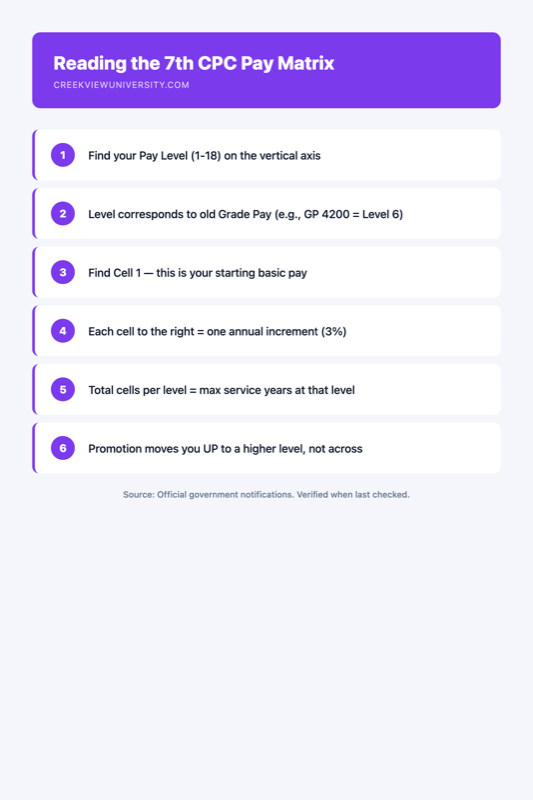
The 7th CPC pay matrix is a grid where vertical levels (1-18) replace the old grade pay and horizontal cells represent annual increments at 3% per year. Your starting salary sits at Cell 1 of your designated level. Level 6, Cell 1 means a basic pay of 35,400 per month.
The 7th Central Pay Commission replaced grade pay and pay bands with a single pay matrix on 1 January 2016. The matrix has 18 vertical levels and 40 horizontal cells. A fitment factor of 2.57 converted every pre-2016 basic pay into the new structure. The minimum entry pay rose from 7,000 to 18,000 per month. Every central government employee from a Multi-Tasking Staff to a Secretary draws salary from this one table.
I checked the recruitment notification format of recent SSC and UPSC advertisements. Every single one now mentions “Pay Level” instead of the old “PB-2, GP 4200” style. If you cannot read the pay matrix, you cannot evaluate whether a post is worth applying for.
What exactly is the 7th CPC pay matrix?
The pay matrix is a pre-calculated salary table issued as Part A of the CPC report’s implementation order. It eliminates the need to add grade pay to a pay band minimum and then calculate increments manually. The matrix does all that arithmetic in advance. You look up your level, find your cell, and that number is your basic pay.
Before 2016, a Lower Division Clerk earned “PB-1 (5200-20200) + Grade Pay 1900.” That meant a minimum basic of 5200 + 1900 = 7100, but actual starting pay was higher due to fitment. The system confused applicants. The 7th CPC collapsed everything into one number per cell.
According to the Department of Expenditure’s implementation order dated 25 July 2016, every employee was placed at the cell equal to or immediately above their existing pay multiplied by 2.57.
Official source Department of Expenditure - 7th CPC ImplementationResolution dated 25.07.2016 replacing pay bands and grade pay with the pay matrix for all central government civilian employees.
doe.gov.in — opens the official site in a new tabHow do I find my level in the pay matrix?
Your level is determined by the grade pay your post carried before 2016, or by the level mentioned in the current recruitment notification. The 7th CPC report maps each old grade pay to exactly one level. There is no ambiguity. Grade Pay 4200 always means Level 6. Grade Pay 4600 always means Level 7.
| Old Grade Pay | New Pay Level | Entry Pay (Cell 1) | Common Posts |
|---|---|---|---|
| 1,800 | Level 1 | 18,000 | MTS, Peon, Group D |
| 1,900 | Level 2 | 19,900 | LDC, Postman, Sorting Assistant |
| 2,400 | Level 4 | 25,500 | UDC, Accountant, Tax Assistant |
| 2,800 | Level 5 | 29,200 | Senior Secretariat Assistant |
| 4,200 | Level 6 | 35,400 | Assistant, Inspector, SSC CGL (initial) |
| 4,600 | Level 7 | 44,900 | Section Officer, Asst. Commissioner (Customs) |
| 4,800 | Level 8 | 47,600 | Assistant Commissioner (Income Tax) |
| 5,400 (PB-2) | Level 9 | 53,100 | Administrative Officer |
| 5,400 (PB-3) | Level 10 | 56,100 | Deputy Director, Under Secretary |
What does the cell number mean and how do increments work?
The cell number is your position on the horizontal axis. Cell 1 is where you start when you join or get promoted to a level. Each subsequent cell represents one annual increment. Cell 5 means you have completed four years of service at that level.
The annual increment is exactly 3% of your current basic pay, rounded to the nearest 100. For Level 6, Cell 1 is 35,400. Cell 2 is 36,500 (35,400 x 1.03 = 36,462, rounded). Cell 3 is 37,600. The compounding is predictable and guaranteed.
Increments are granted on 1 July every year, provided you have completed six months of service at your current cell. If you joined on 1 January, your first increment comes on 1 July the same year.
What is the difference between basic pay, gross pay, and take-home?
Basic pay is the cell value from the pay matrix. Gross pay is basic plus all allowances (DA, HRA, TA). Take-home is gross minus deductions (NPS/GPF, income tax, CGHS). These three numbers can differ by 40-60%.
The crucial date in your application determines when you join, which affects your first increment date. But your starting basic pay is always Cell 1 of your level.
| Component | Calculation | Monthly Amount |
|---|---|---|
| Basic Pay | Level 6, Cell 1 | 35,400 |
| Dearness Allowance (60%) | 35,400 x 0.60 | 21,240 |
| HRA (30% — X city) | 35,400 x 0.30 | 10,620 |
| Transport Allowance | Fixed (metro city) | 7,200 |
| Gross Pay | 74,460 | |
| NPS Deduction (10%) | (35,400 + 21,240) x 0.10 | -5,664 |
| CGHS + Prof. Tax | Fixed | -700 |
| Approximate Take-Home | 68,096 |
My judgement: candidates obsess over the entry-level comparison between SSC CGL (Level 6/7) and a private sector salary of 8-10 LPA. The comparison is misleading. Government pay is back-loaded. The real advantage shows after 10-15 years when increments, promotions, DA hikes, and pension benefits compound. Evaluate the matrix as a 30-year trajectory, not a starting-salary snapshot.
Official source 7th CPC Implementation Order - DoEOffice Memorandum dated 25.07.2016 specifying the pay matrix, fitment table, and increment rules for all central government civilian employees.
doe.gov.in — opens the official site in a new tabHow do I calculate approximate in-hand salary from any basic pay?
Use this rough formula for a quick estimate. It works for any level between 1 and 10, for employees posted in metro cities:
Approximate gross = Basic Pay x 2.0 (accounts for DA at 60%, HRA at 30%, transport allowance).
Approximate take-home = Gross minus 10-12% (NPS contribution on basic + DA, plus minor deductions).
For Level 7 (SSC CGL Section Officer post): Basic 44,900 x 2.0 = approximately 89,800 gross. After NPS deduction, take-home is roughly 82,000-83,000 before income tax.
For fee exemption rules at the application stage and photo and signature specifications, see our dedicated guides.
Frequently Asked Questions
Does the pay matrix apply to state government employees?
No. The 7th CPC pay matrix applies only to central government civilian employees. State governments constitute their own pay commissions with different level numbers and cell values.
What happens to my cell number when I get promoted?
On promotion, you move to the next higher level. Your new cell is determined by locating pay in the new level equal to or above your current pay plus one increment. You start at Cell 1 or higher depending on your existing pay.
Is the 3% increment guaranteed every year?
Yes. The increment is withheld only as a penalty under CCS (CCA) Rules for serious misconduct. With a satisfactory APAR, it is automatic on 1 July every year.
When will the 8th Pay Commission change this matrix?
The 8th Pay Commission was constituted in January 2024 with a mandate to submit recommendations by 2025-end for implementation from 1 January 2026. The final report has not been implemented yet. Until then, the 7th CPC matrix remains operative.
Sources
- 7th Central Pay Commission Report, Part A (Pay Matrix Tables) — implemented 25 July 2016
- Department of Expenditure, Ministry of Finance — O.M. No. 1/1/2016-IC dated 25.07.2016
- CCS (Revised Pay) Rules, 2016 — Rule 10 (Increment) and Rule 13 (Pay on Promotion)
- Department of Expenditure — O.M. on revised DA rate effective 01.01.2026
This article is an independent explainer. Creekview is not a government body, not affiliated with any recruitment board, and not a university. Read how we research government recruitment topics.
Related guides
-
HRA Rates for X, Y, and Z Category Cities in Central Government
Central government employees receive House Rent Allowance at 24%, 16%, or 8% of basic pay depending on city classification. X…
-
What Is Dearness Allowance and How Is It Calculated?
Dearness Allowance is a cost-of-living adjustment paid as a percentage of basic pay, revised every January and July. The current…