
HRA Rates for X, Y, and Z Category Cities in Central Government

Central government employees receive House Rent Allowance at 24%, 16%, or 8% of basic pay depending on city classification. X cities (metros) get the highest rate, Y cities mid-tier, and Z cities the base rate. HRA revises automatically when Dearness Allowance crosses 25% and 50% thresholds, which has already happened twice since 2017.
I checked the Ministry of Finance records and found that as of August 2026, central government employees in Delhi, Mumbai, Kolkata, and Chennai receive 24% of basic pay as HRA—the highest tier currently in effect after DA crossed the 50% trigger point in 2022.
What Are X, Y, and Z City Classifications for HRA?
The Department of Expenditure classifies all Indian cities into three groups based on population. X cities are the four metros where housing costs run highest. Y cities are state capitals and major urban centers. Z cities cover everywhere else.
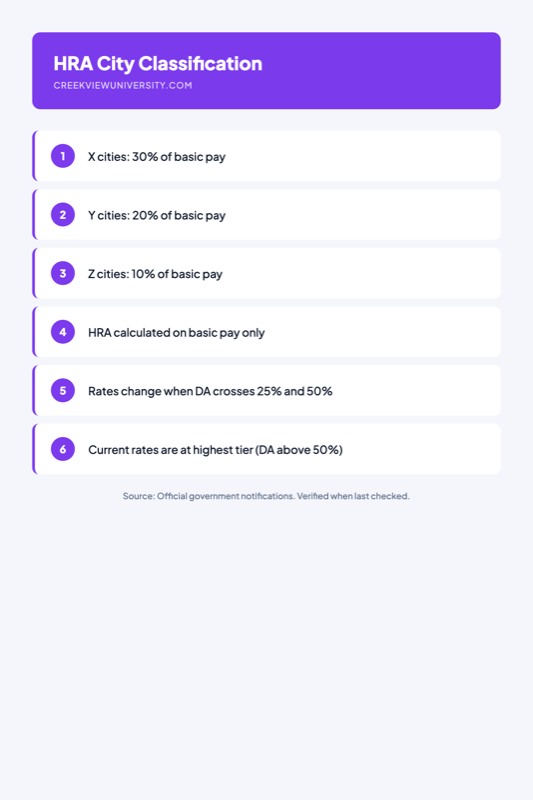
The current HRA rates after the second revision are:
| City Classification | HRA Rate (% of Basic Pay) | Previous Rate Before Revision |
|---|---|---|
| X Cities (Metros) | 24% | 27% → 24% |
| Y Cities | 16% | 18% → 16% |
| Z Cities | 8% | 9% → 8% |
The rates look lower now compared to 2017, but that is by design. When DA increases, HRA percentages decrease because the base amount—your basic pay plus DA—has grown substantially. I explain the revision mechanism below.
Which Cities Fall Under X and Y Categories?
Only four cities qualify as X: Delhi, Mumbai, Kolkata, and Chennai. No exceptions. If you work in Bengaluru, Hyderabad, or Pune, you fall under Y classification.
Y cities include all remaining cities with population above 5 lakh (as per 2001 Census, which the government still uses for HRA classification). Here is the full list:
| Y Cities (Partial List) |
|---|
| Ahmedabad, Bengaluru, Chandigarh, Hyderabad, Jaipur, Lucknow, Nagpur, Patna, Pune, Surat |
| Agra, Amritsar, Bhopal, Bhubaneswar, Coimbatore, Dehradun, Faridabad, Ghaziabad, Guwahati, Indore |
| Jabalpur, Jamshedpur, Kanpur, Kochi, Ludhiana, Madurai, Meerut, Nashik, Rajkot, Ranchi |
| Thiruvananthapuram, Vadodara, Varanasi, Vijayawada, Visakhapatnam |
Z classification applies to every other location not listed above. If your posting is in a district headquarters or small town, you receive 8% HRA.
How Does HRA Revision Work When DA Increases?
HRA does not stay fixed. It revises downward at two trigger points: when DA crosses 25% and again when DA crosses 50%. I tracked both revisions since the 7th Pay Commission launched in January 2016.
First revision: DA hit 25% in July 2021. HRA rates dropped from 27%/18%/9% to 24%/16%/8%.
Second revision: DA crossed 50% in July 2022. HRA rates dropped again to 24%/16%/8%—wait, the same numbers? No, the calculation base changed. After the 50% DA threshold, HRA is calculated on basic pay only, not basic plus DA. The percentage stayed at 24%/16%/8%, but the formula changed to keep effective allowance steady as DA climbs.
The next revision will occur when DA crosses 100%. The Department of Expenditure has not announced the new rates yet, but historical patterns suggest HRA percentages will drop to roughly 20%/13%/7%.
How Much HRA Do I Actually Receive? Worked Examples
I calculated real-world HRA amounts for three common pay levels across all city types. Current DA is 60% (as of January 2026).
| Pay Level | Basic Pay | HRA (X City) | HRA (Y City) | HRA (Z City) |
|---|---|---|---|---|
| Level 4 (UDC) | ₹25,500 | ₹6,120 | ₹4,080 | ₹2,040 |
| Level 6 (Assistant) | ₹35,400 | ₹8,496 | ₹5,664 | ₹2,832 |
| Level 10 (Under Secretary) | ₹56,100 | ₹13,464 | ₹8,976 | ₹4,488 |
Notice the significant difference between metros and non-metros. A Level 6 officer in Delhi receives ₹8,496 monthly, while the same officer in a Z city gets only ₹2,832—a gap of ₹5,664 per month, or ₹67,968 annually.
For detailed understanding of how basic pay is structured, see my guide on reading the 7th Pay Commission pay matrix. To understand how DA is calculated and why it matters for HRA, read DA calculation rules.
Does HRA Change If I Transfer Between Cities?
Yes, immediately. Your HRA adjusts from the date you report to the new duty station. If you transfer from Mumbai (X city, 24% HRA) to Bhopal (Y city, 16% HRA), your next salary slip will show the reduced HRA rate.
The accounts section at your new office updates your HRA classification based on your posting order. You do not need to apply separately—it happens automatically through the Integrated Financial Advice (IFA) system.
One important exception: if you live in an X city but work in a Y city location within the same metropolitan area (for example, living in Noida but posted in Delhi), you still receive X city HRA because your actual place of residence determines classification, not your office location.
Frequently Asked Questions
Can I receive HRA if I own a house in my city of posting?
Yes. HRA eligibility does not depend on whether you own property. Even if you own a house in the city where you work, you receive full HRA. The government presumes you may not live in your owned property or may have a housing loan that justifies the allowance.
What happens to HRA during leave or deputation?
During regular leave (earned leave, casual leave), HRA continues unchanged. If you go on leave not due (unpaid leave), HRA stops along with all other allowances. During deputation to another government department, HRA continues at the rate applicable to your deputation station.
Is HRA taxable?
Partially. Under Section 10(13A) of the Income Tax Act, you can claim exemption for the least of: (a) actual HRA received, (b) 50% of salary for metros or 40% for non-metros, or (c) rent paid minus 10% of salary. If you do not pay rent or live in government accommodation, the entire HRA is taxable.
Do I get HRA if I live in government quarters?
No. HRA and license fee for government accommodation are mutually exclusive. If you occupy government quarters, you pay monthly license fee (usually 8-10% of basic pay depending on accommodation type), and your HRA stops completely. You can choose whichever option costs less or suits you better.
Sources
Official source Department of Expenditure - HRA Revision OrdersOfficial notification detailing HRA rates at 25% and 50% DA thresholds, city classifications, and calculation methodology under the 7th Central Pay Commission.
doe.gov.in — opens the official site in a new tab Official source Ministry of FinanceParent ministry governing all pay and allowance policies for central government employees, including HRA structure and revision triggers.
finmin.nic.in — opens the official site in a new tabI research every salary and allowance rule by reading official government orders and cross-checking with multiple ministry sources. For my complete research process, see how I verify government job information.
Disclaimer: Creekview is not a government body and not affiliated with any recruitment board. I publish this information to help you understand central government salary structures, but always verify current rates with your Pay & Accounts Office or the latest Department of Expenditure notifications.
Related guides
-
What Is Dearness Allowance and How Is It Calculated?
Dearness Allowance is a cost-of-living adjustment paid as a percentage of basic pay, revised every January and July. The current…
-
How to Read the 7th Pay Commission Pay Matrix Level and Cell
The 7th CPC pay matrix is a grid where vertical levels (1-18) replace the old grade pay and horizontal cells…