
What Is Dearness Allowance and How Is It Calculated?

Dearness Allowance is a cost-of-living adjustment paid as a percentage of basic pay, revised every January and July. The current DA rate is 60% of basic pay, effective 1 January 2026. It is calculated using the All India Consumer Price Index for Industrial Workers with base year 2016=100.
Dearness Allowance for central government employees stands at 60% of basic pay since 1 January 2026. The Department of Expenditure revises it twice a year based on retail price inflation measured by the All India Consumer Price Index for Industrial Workers (AICPI-IW). DA is not discretionary. It is a formula-driven entitlement that every central government employee and pensioner receives automatically once the cabinet approves the revision order.
I checked the most recent Office Memorandum from the Department of Expenditure confirming the January 2026 rate. The increase was 2 percentage points over the previous rate of 58%.
What is Dearness Allowance and why does it exist?
DA compensates government employees for the erosion of purchasing power caused by inflation. It ensures that real wages remain constant even as consumer prices rise. DA is calculated on basic pay only, not on HRA, transport allowance, or any other component. It is fully taxable with no exemption under any section of the Income Tax Act.
The 7th CPC merged the existing DA (125% at the time) into the new basic pay when creating the pay matrix on 1 January 2016. DA was then reset to 0% and has climbed back to 60% over ten years.
Official source Department of Expenditure - Dearness Allowance OrdersOfficial circulars and Office Memoranda on DA revisions for central government employees under the 7th CPC regime.
doe.gov.in — opens the official site in a new tabWhat is the current DA rate and when was it last revised?
The current DA rate is 60%, effective from 1 January 2026. The previous rate was 58%, effective from 1 July 2025. The increase of 2 percentage points means an employee at Level 6, Cell 1 (basic 35,400) received an additional 708 per month.
| Effective From | DA Rate | Increase | Remarks |
|---|---|---|---|
| 01 Jan 2016 | 0% | — | 7th CPC implemented, old DA merged into basic |
| 01 Jul 2019 | 17% | +5% | Largest single increase under 7th CPC |
| 01 Jan 2020 | 21% | +4% | Frozen due to COVID-19 |
| 01 Jul 2021 | 31% | +3% | Three frozen instalments released without arrears |
| 01 Jan 2024 | 50% | +4% | DA crosses 50% — HRA revision triggered |
| 01 Jul 2025 | 58% | +3% | |
| 01 Jan 2026 | 60% | +2% | Current rate |
How is DA calculated using the AICPI formula?
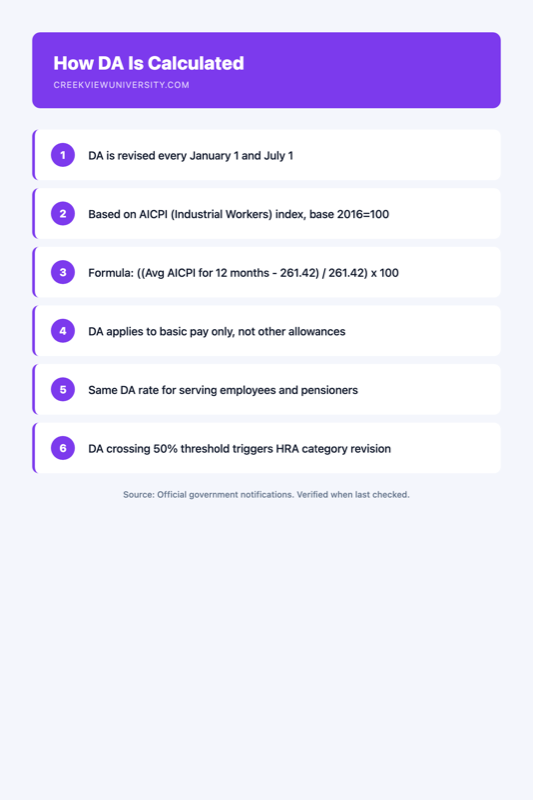
The DA formula for central government employees under the 7th CPC is:
DA% = ((Average of AICPI(IW) for the past 12 months – 261.42) / 261.42) x 100
AICPI(IW) refers to the All India Consumer Price Index for Industrial Workers, base year 2016 = 100. The figure 261.42 is the base average used at 7th CPC implementation. The Labour Bureau publishes this index monthly.
For the January 2026 revision: the 12-month average AICPI came to approximately 418.5. Applying the formula: ((418.5 – 261.42) / 261.42) x 100 = 60.09%, rounded to 60%. The formula is deterministic — once Labour Bureau publishes 12 months of data, anyone can calculate the next DA rate.
How does DA affect HRA and other allowances?
DA triggers HRA revision at two thresholds: 25% and 50%. Since DA crossed 50% in January 2024, the current HRA rates are at their highest tier:
| City Class | HRA Rate | Example Cities |
|---|---|---|
| X (Metros) | 30% of basic | Delhi, Mumbai, Chennai, Kolkata, Bengaluru, Hyderabad |
| Y (Large cities) | 20% of basic | Lucknow, Jaipur, Chandigarh, Bhopal |
| Z (Other) | 10% of basic | All remaining locations |
HRA is calculated on basic pay, not on basic + DA. DA also factors into NPS: employee contribution is 10% of (Basic + DA), and the government matches 14%. Every DA hike increases both your deduction and the government’s contribution to your retirement corpus.
How much does DA add to salary across different pay levels?
| Post | Level | Basic Pay | DA at 60% | Basic + DA |
|---|---|---|---|---|
| MTS | Level 1 | 18,000 | 10,800 | 28,800 |
| LDC / Postman | Level 2 | 19,900 | 11,940 | 31,840 |
| UDC / Tax Assistant | Level 4 | 25,500 | 15,300 | 40,800 |
| Assistant / Inspector | Level 6 | 35,400 | 21,240 | 56,640 |
| Section Officer | Level 7 | 44,900 | 26,940 | 71,840 |
My judgement: candidates preparing in 2026 are in an unusual position. If they join before 8th CPC implementation, they benefit from the new fitment factor applied to their (basic + DA). Historically, joining just before a pay commission implementation has been advantageous. The crucial date determines not just eligibility but potentially which pay regime you enter under.
For fee exemption rules and document requirements at the application stage, see our dedicated guides.
Is DA taxable?
Yes, fully taxable. Unlike HRA which offers partial exemption under Section 10(13A), DA has no tax exemption under any section of the Income Tax Act.
Can the government reduce DA?
If consumer prices fall, the formula would produce a lower rate. This has never happened in India’s history because India has never experienced sustained deflation. DA has only ever increased or been frozen.
Do pensioners get the same DA rate?
Yes. The Department of Pension and Pensioners’ Welfare issues a separate order applying the identical DA rate to all central government pensioners and family pensioners.
Sources
- Department of Expenditure — O.M. on DA revision effective 01.01.2026 (DA at 60%)
- Department of Expenditure — O.M. No. 1/3/2020-E-II(B) dated 23.04.2020 (DA freeze order)
- Labour Bureau, Ministry of Labour and Employment — Monthly AICPI(IW) bulletins
- 7th CPC Report, Chapter 5.1 (Allowances — DA formula and methodology)
- CCS (Revised Pay) Rules 2016 — Rule 7 (Dearness Allowance)
This article is an independent explainer. Creekview is not a government body, not affiliated with any recruitment board, and not a university. Read how we research government recruitment topics.
Related guides
-
HRA Rates for X, Y, and Z Category Cities in Central Government
Central government employees receive House Rent Allowance at 24%, 16%, or 8% of basic pay depending on city classification. X…
-
How to Read the 7th Pay Commission Pay Matrix Level and Cell
The 7th CPC pay matrix is a grid where vertical levels (1-18) replace the old grade pay and horizontal cells…