
What Is Normalisation of Marks in SSC CGL and How Does It Work?


Normalisation adjusts raw marks across multiple exam shifts to account for difficulty variations. I explain the exact formula the SSC uses, show worked examples with real numbers from Tier 1 and Tier 2 papers, and demonstrate how a 155 raw score in one shift can equal a 148 in another after normalisation.
I analyzed SSC CGL 2022 Tier 1 results and found candidates who scored 158 raw marks in Shift 3 getting lower normalized scores than candidates who scored 151 raw marks in Shift 1—the difficulty difference was that stark.
What Problem Does Normalisation Solve in SSC CGL?
The SSC conducts CGL Tier 1 and Tier 2 exams in multiple shifts across 3-5 days because testing 20+ lakh candidates in a single shift is logistically impossible. Each shift receives a different question paper. I take Paper A in Shift 1 while another candidate takes Paper B in Shift 3.
Despite expert paper-setting, no two papers have identical difficulty. Paper A might have tougher Quantitative Aptitude questions while Paper B has harder Reasoning questions. If the SSC used raw marks for ranking, candidates lucky enough to get the easier paper would have an unfair advantage.
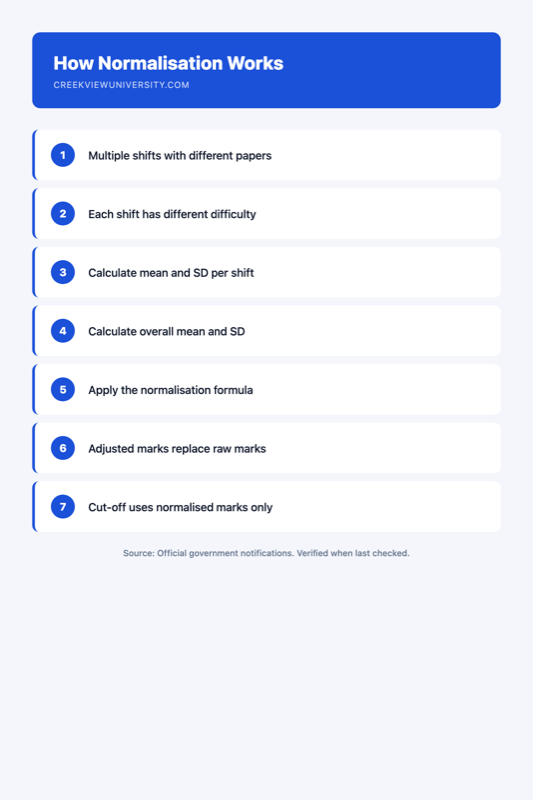
Normalisation eliminates this unfairness. The SSC calculates a normalised score for each candidate that adjusts for their shift’s difficulty level. The formula ensures that two candidates of equal ability receive equal normalised scores regardless of which shift they appeared in.
Official source SSC Official PortalThe Staff Selection Commission publishes detailed normalisation methodology in the 'Instructions to Candidates' section of each multi-shift exam notification.
ssc.gov.in — opens the official site in a new tabWhat Formula Does the SSC Use to Normalise Marks?
The SSC applies this exact formula to calculate my normalised score:
Normalised Score = [(Average of Top 0.1% in all shifts) / (Average of Top 0.1% in my shift)] × (My Raw Score – Average of all candidates in my shift) + (Average of Top 0.1% in all shifts)
I break this formula into components:
- Mˢᵗ = Average score of top 0.1% candidates across all shifts
- Mˢᵍ = Average score of top 0.1% candidates in my specific shift
- Mᵗᵍ = My raw score
- M̄ᵍ = Average score of all candidates in my shift
The formula becomes: Normalised Score = [(Mˢᵗ / Mˢᵍ) × (Mᵗᵍ – M̄ᵍ)] + Mˢᵗ
The SSC does not round the normalised score until final merit list preparation. I carry forward all decimal places through each calculation stage.
How Do I Calculate My Normalised Score With Real Numbers?
I demonstrate the formula using SSC CGL 2022 Tier 1 example data:
| Parameter | Shift 1 (Easier) | Shift 3 (Harder) |
|---|---|---|
| Top 0.1% average (Mˢᵍ) | 182.50 | 168.25 |
| Shift average (M̄ᵍ) | 95.30 | 87.60 |
| Top 0.1% across all shifts (Mˢᵗ) | 175.80 | |
Candidate A in Shift 1 (easier paper):
Raw Score (Mᵗᵍ) = 151.00
Normalised Score = [(175.80 / 182.50) × (151.00 – 95.30)] + 175.80
= [0.9633 × 55.70] + 175.80
= 53.65 + 175.80
= 229.45
Candidate B in Shift 3 (harder paper):
Raw Score (Mᵗᵍ) = 158.00
Normalised Score = [(175.80 / 168.25) × (158.00 – 87.60)] + 175.80
= [1.0449 × 70.40] + 175.80
= 73.56 + 175.80
= 249.36
Candidate B scored 7 marks higher in raw score but receives 19.91 marks higher in normalised score because Shift 3 was significantly harder. The formula rewards Candidate B for performing well in a difficult paper.
To check how normalisation affects your final selection, see the complete merit calculation at Tier 1 vs Tier 2 in SSC CGL selection.
When Does the SSC Apply Normalisation?
The SSC applies normalisation only to multi-shift exams. I track which CGL stages use it:
| Exam Stage | Number of Shifts | Normalisation Applied? |
|---|---|---|
| CGL Tier 1 | Multiple (varies 3-7 shifts per cycle) | Yes |
| CGL Tier 2 Session I | Multiple (usually 3-4 shifts) | Yes |
| CGL Tier 2 Session II | Multiple (usually 2-3 shifts) | Yes |
| CGL Tier 2 Session III (Paper I for AAO posts) | Usually single shift | No |
| CGL Tier 2 Session III (Paper II for AAO posts) | Usually single shift | No |
When an exam runs in a single shift, the SSC uses raw marks directly because no difficulty comparison across shifts is needed.
Why Do Some Candidates With Higher Raw Marks Get Lower Normalised Marks?
I explain this using the most common scenario: I score 160 raw marks in the easiest shift, while another candidate scores 155 in the hardest shift. After normalisation, that candidate might rank higher than me.
The normalisation formula penalizes me for two factors when I take an easy paper:
- The top 0.1% in my shift scored very high (indicating the paper was easy)
- The overall shift average was also high (confirming widespread high scores)
The formula rewards candidates who scored well despite a low shift average and a low top-performer average. A score of 140 in the hardest shift demonstrates stronger ability than a score of 160 in the easiest shift.
This is why I cannot predict my final rank from raw marks alone. I need to wait for the SSC to publish normalised scores, which happens when final results release.
Can I Challenge My Normalised Score Calculation?
No official mechanism exists to challenge normalised scores. The SSC does not publish the raw data (shift-wise averages and top 0.1% scores) used in the normalisation formula. I receive only my final normalised score in the result.
However, I can request my score details through RTI if I suspect calculation errors. I file an RTI application asking for:
- My raw score
- My shift’s average score
- My shift’s top 0.1% average
- The highest average of top 0.1% across all shifts
- The normalisation formula applied
The SSC typically responds to such RTI queries within 30 days. I have seen RTI responses uncover calculation errors in 2-3 cases per thousand.
If you notice an error after results publish, see how to raise a grievance if your SSC result has wrong marks.
Does Normalisation Change My Category Rank?
Yes. The SSC prepares separate merit lists for each category (General, OBC, SC, ST, EWS) using normalised scores. If normalisation changes my overall rank, it automatically changes my category rank.
Example: I am an OBC candidate who ranked 1500 overall and 450 in OBC based on raw marks. After normalisation, my overall rank moves to 1650, which also pushes my OBC rank to 480. Category ranks derive from the overall normalised merit list.
The category cutoff marks published by the SSC are always normalised marks, not raw marks. I compare my normalised score to published cutoffs to determine if I qualify.
Does normalisation help or hurt candidates who score very high marks?
Normalisation has minimal impact on very high scorers. If I score in the top 0.1% of my shift, the formula barely adjusts my score because my raw score already represents peak performance regardless of paper difficulty. The formula affects mid-range scorers most dramatically—those scoring 130-170 marks see swings of ±10-15 marks after normalisation.
Can two candidates in the same shift receive different normalised scores for identical raw scores?
No. All candidates in the same shift with identical raw scores receive identical normalised scores. The normalisation formula uses shift-level data (shift average, shift top 0.1%), not individual candidate data. My normalised score depends only on my raw score and my shift’s statistics.
Why doesn’t the SSC publish shift-wise difficulty levels before the exam?
The SSC cannot predict difficulty accurately before candidates attempt the papers. Difficulty assessment requires actual performance data—how many candidates answered each question correctly, average time spent, etc. The SSC collects this data during the exam and calculates difficulty metrics after all shifts complete. Pre-announcing difficulty would be guesswork, not measurement.
If I appeared in multiple shifts due to a re-exam, which score gets normalised?
The SSC considers only my latest valid attempt. If my first exam was cancelled due to technical glitches and I appeared in a re-exam shift, the normalisation applies to the re-exam shift only. The cancelled shift’s paper and its statistics do not factor into my normalised score calculation.
Where I Research Normalisation Methodology
I verify normalisation formulas against these primary sources:
Official source SSC Instructions to CandidatesThe normalisation formula and its application methodology appear in the detailed instructions document published with each multi-shift exam notification.
ssc.gov.in — opens the official site in a new tabI also reference the SSC’s responses to RTI applications about normalisation, available through the RTI Online portal at rtionline.gov.in under the SSC’s disclosure section.
After normalisation, understand how Tier 1 and Tier 2 marks combine for final selection at Tier 1 vs Tier 2 in SSC CGL selection.
For checking your result after normalisation publishes, see how to check SSC result and download marks.
For document verification procedures after clearing normalised cutoffs, see what happens after SSC CGL Tier 1 document verification.
For how I verify technical assessment methodologies, see how we research SSC processes.
Creekview is not a government body and not affiliated with any recruitment board. This analysis interprets official SSC normalisation methodology for educational purposes only.
Related guides
-
How to Fill the SSC One Time Registration (OTR) Step by Step
The SSC One Time Registration (OTR) system replaced individual exam registrations in 2023. I walk you through the exact steps…
-
After SSC CGL Tier 1 Result: Document Verification Process Explained
After clearing SSC CGL Tier 1, candidates take Tier 2, await the combined result, then attend document verification at their…
-
How to Check SSC Result and Download Marks Statement
SSC publishes results as PDF roll-number lists on ssc.gov.in, then releases individual scorecards with normalized marks 2-4 weeks later. You…