
Do You Need Domicile Certificate for Central Government Jobs?


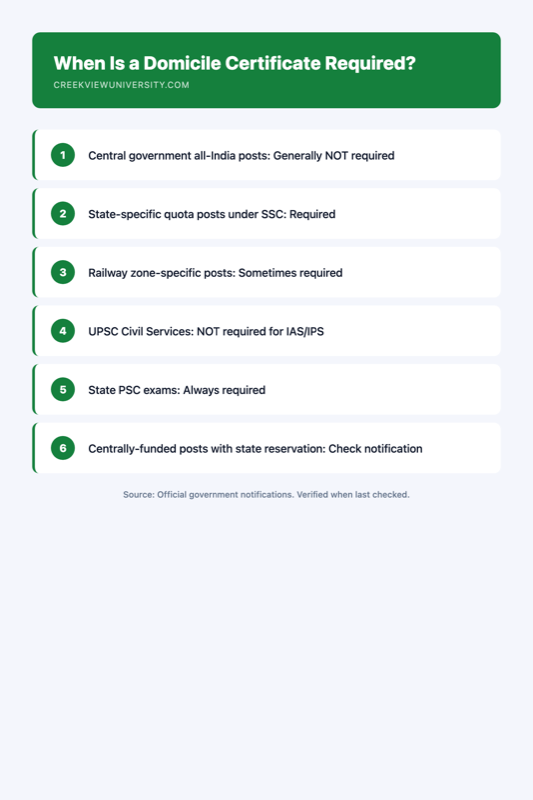
Domicile certificate is not required for most central government jobs. Article 16(2) of the Constitution prohibits residence-based discrimination in public employment. However, certain Group C posts filled through SSC and Railways do carry state-specific domicile conditions where Parliament has carved exceptions under Article 16(3).
Article 16(2) of the Indian Constitution uses seven words that settle this question: no citizen shall be discriminated against on grounds of residence. The provision dates to 26 January 1950. Parliament enacted the Public Employment (Requirement as to Residence) Act in 1957 to allow domicile conditions for a handful of states. That Act was repealed on 28 December 1974. Since then, no central legislation imposes a blanket domicile requirement for Union government posts.
I checked the recruitment notifications of UPSC, SSC, and Railway Recruitment Boards for the 2024-2025 cycle. The pattern is consistent: the eligibility section says “Indian citizen” and lists age, educational qualification, and category. Domicile appears only against specific posts where the appointing ministry has notified a regional requirement under Article 16(3).
What does Article 16 actually say about domicile and government jobs?
Article 16 settles the constitutional position in three clauses. Clause 1 guarantees equality of opportunity. Clause 2 bars discrimination based on residence. Clause 3 gives Parliament a narrow power to impose residence requirements for specific state-level posts. The combined effect: domicile cannot be a general condition for central services.
The Supreme Court in Kailash Chand Sharma v. State of Rajasthan (2002) reinforced this principle. The position is settled law, not a grey area.
Official source Article 16, Constitution of IndiaClause 2 prohibits discrimination based on residence in public employment; Clause 3 permits Parliament to create narrow exceptions.
www.constitutionofindia.net — opens the official site in a new tabIs domicile required for UPSC Civil Services, SSC CGL, or Railways?
UPSC Civil Services: No. The notification every year lists nationality, age, and educational qualification. Domicile is not part of the DV checklist for IAS, IPS, IFS, or any Central Service. Cadre allocation involves state preference, but this is post-selection assignment, not an eligibility barrier.
SSC CGL: No universal requirement. Fewer than 5 out of 40+ post categories in the 2024 notification carried any state-specific condition. Posts like Inspector (GST/Customs), Tax Assistant, and Auditor are open to all Indian citizens.
Railways: RRB applications go to a specific zone, but you can apply to any RRB regardless of residence. RPF recruitment sometimes specifies state-wise vacancies where domicile is required.
| Exam | Post | Domicile Required? | Authority |
|---|---|---|---|
| UPSC CSE | IAS, IPS, IFS, all Central Services | No | Article 16(2) |
| SSC CGL | Inspector (GST/Customs), Tax Assistant | No | SSC notification |
| SSC CGL | Sub-Inspector (NIA) — select cycles | Yes (specific vacancies) | MHA |
| RRB NTPC | Station Master, Clerk, Typist | No | Railway Board CEN |
| RPF | Constable / Sub-Inspector | Yes (state-wise vacancies) | Railway Board / MHA |
| SSC GD | BSF, CISF, CRPF, SSB, ITBP | No (state allocation at joining) | CAPFs |
| Delhi Police | Constable / Head Constable | No | SSC / Delhi Police |
What is the difference between domicile, native place, and permanent address?
Domicile certificate is a legal document from a state revenue authority certifying permanent residence. It carries legal weight under Article 16(3). Native place is your place of origin in educational records — no legal standing for recruitment. Permanent address is the address on your Aadhaar or voter ID — does not establish domicile.
If a notification says “domicile of Rajasthan required,” only the domicile certificate from Rajasthan revenue authority will be accepted. Your Aadhaar showing a Jaipur address will not suffice.
How do you get a domicile certificate if a post requires one?
Apply through the state’s e-District portal (e.g., edistrict.up.gov.in for UP, aaplesarkar.mahaonline.gov.in for Maharashtra). Submit proof of residence (ration card, voter ID, property documents), identity proof, and wait for revenue inspector verification. Most states issue within 15-30 days. Residence duration requirements differ: UP requires 3 years, Maharashtra requires birth in state or 15 years of residence.
My judgement: if you are applying for SSC CGL, do not obtain a domicile certificate pre-emptively. Read the notification for the specific posts you are targeting. Most applicants will never need one. For candidates who have moved between states: you can only hold domicile of one state at a time.
For the documents you will actually need at DV, see our guides on OBC certificate validity and EWS certificate issuing authority.
Can I apply for SSC CGL without a domicile certificate?
Yes. The vast majority of CGL posts do not require domicile. Only check if your specific target post has a state-level condition, which is rare.
Is domicile the same as caste or EWS certificate?
No. Domicile proves state residence. OBC certificate proves backward class status, EWS certificate proves economic status. They are issued by different authorities for different purposes.
Does UPSC ask for domicile at any stage?
No. UPSC does not ask for domicile at prelims, mains, personality test, or final document verification. Cadre preference is separate from domicile eligibility.
Sources
- Article 16, Constitution of India — constitutionofindia.net
- UPSC CSE 2025 Notification — upsc.gov.in
- SSC CGL 2024 Notification — ssc.gov.in
- DoPT establishment rules — dopt.gov.in
- Kailash Chand Sharma v. State of Rajasthan (2002), Supreme Court of India
- Public Employment (Requirement as to Residence) Act, 1957 (repealed 1974)
Creekview is not a government body and not affiliated with any recruitment board. Read how we research government recruitment topics.
Related guides
-
Character Certificate and Police Verification for Government Jobs
Character certificate and police verification are two distinct processes. Character certificate is a document from your institution or gazetted officer…
-
Does an OBC certificate expire? What the DoPT order actually says
There is no fixed validity period for an OBC certificate. The Department of Personnel and Training said so in 2003…
-
Two ₹8 lakh limits, two completely different tests: EWS and the OBC creamy layer
The OBC creamy-layer limit and the EWS income limit are both ₹8 lakh, and that is where the similarity ends.…