
Character Certificate and Police Verification for Government Jobs

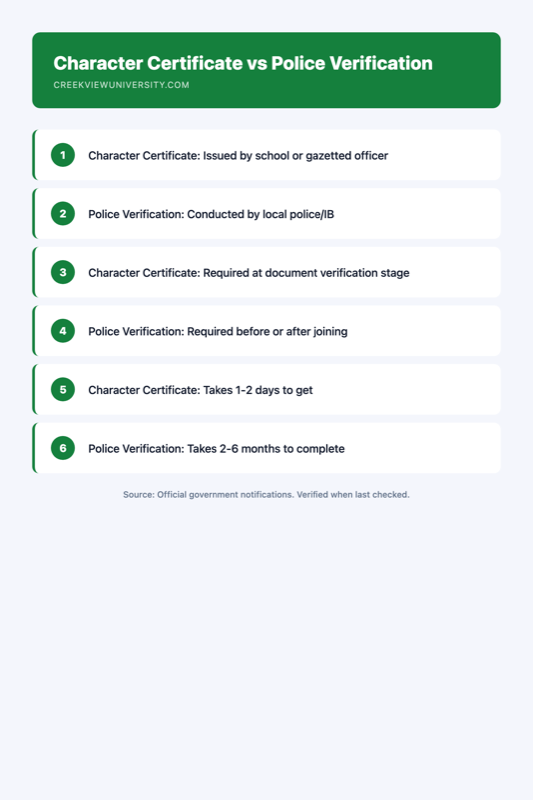
Character certificate and police verification are two distinct processes. Character certificate is a document from your institution or gazetted officer submitted at document verification. Police verification is an investigation by local police into your criminal record, conducted before or after appointment. Both are mandatory but serve different purposes at different stages.
Every central government appointment in India passes through a verification gate. DoPT Office Memorandum No. 18011/1(S)/2014-Estt.(B) governs the process. The Ministry of Home Affairs issued separate guidelines on 30 March 2015 covering police verification specifically. Between these two frameworks, a candidate faces two checks: a character certificate submitted during document verification and a police investigation conducted by law enforcement.
The confusion between these two processes causes genuine anxiety among candidates. A character certificate is something you obtain and submit. Police verification is something that happens to you. The stakes are different: a missing character certificate delays your joining, but an adverse police verification report can cancel your appointment entirely.
What is the difference between character certificate and police verification?
| Parameter | Character Certificate | Police Verification |
|---|---|---|
| Issued by | Educational institution head or gazetted officer | Local police (SHO/SP) via state police HQ |
| When required | Document verification stage | Before or after appointment (varies by post) |
| What it checks | General conduct and moral character (testimonial) | Criminal record, pending cases, FIRs, court orders |
| Who initiates | Candidate obtains and submits it | Appointing authority sends request to police |
| Timeline | 1-7 days to obtain | 2-6 months (state-dependent) |
| Legal basis | DoPT OM on document verification | MHA guidelines dated 30.03.2015 |
| Consequence if adverse | Asked to provide alternative certificate | Appointment can be cancelled or deferred |
DoPT OM 18011/1(S)/2014-Estt.(B) governs verification of character and antecedents for government appointments.
dopt.gov.in — opens the official site in a new tabWho can issue a valid character certificate?
Three authorities: the head of your last educational institution (principal, dean, or vice-chancellor), any gazetted officer (Group A or B) who has known you personally for at least one year, or your current department head if you are already in government service. The certificate should be recent — most recruiting bodies accept certificates issued within the preceding 6-12 months.
What does police verification actually check?
Police verification is a structured investigation checking five specific areas under MHA guidelines:
- Criminal record check: Cases registered against you at any police station, verified through the CCTNS database (nationwide since 2017).
- Court case verification: Pending cases, FIRs, chargesheets, bail status.
- Antecedent verification: Local police visit your neighbourhood to verify reputation.
- Address verification: Physical verification of permanent and present address.
- Identity verification: Cross-check against electoral rolls, Aadhaar, revenue records.
For sensitive posts (IB, RAW, NIA, nuclear establishments), Intelligence Bureau verification applies — deeper, covers family members, and can take 6-12 months.
How long does police verification take?
MHA guidelines prescribe 60 days. Actual timelines vary dramatically: Delhi 30-60 days, Maharashtra 45-90 days, UP 3-6 months, Bihar 4-6 months. If you have lived in multiple states, verification goes to each state separately. The total time equals the slowest state.
For Group C posts where joining happens before verification completes, the appointment is provisional — the offer letter states “subject to satisfactory police verification.”
Official source Ministry of Home AffairsMHA guidelines dated 30.03.2015 prescribe the scope and procedure for police verification of government candidates.
www.mha.gov.in — opens the official site in a new tabCan concealment of a criminal case block your appointment even after acquittal?
Yes. This is the most important principle from Avtar Singh v. Union of India (2016) 8 SCC 471. The Supreme Court drew a clear distinction: the existence of a case may not disqualify you, but deliberately hiding it in the attestation form will. The attestation form asks specific questions about arrests, prosecution, and pending cases. If you answer “No” when the truth is “Yes,” you have committed concealment regardless of case outcome.
My judgement: always disclose everything in the attestation form. An honest disclosure of a minor acquitted case will almost never block your appointment. A concealed acquitted case will block it permanently when discovered — and with CCTNS digitisation, it will be discovered.
Which posts require police verification before joining vs after?
Before joining (mandatory): IB, RAW, NIA, all CAPFs (BSF, CRPF, CISF, ITBP, SSB), RPF, nuclear establishments, posts involving classified documents.
After joining (provisional appointment): Group C posts in most civil ministries (filled through SSC CGL, CHSL), Railway Group C and D (non-RPF), attached/subordinate offices.
The crucial date in your notification affects when you must produce all documents. For the full DV document checklist, see our OBC certificate validity and EWS issuing authority guides.
Can a traffic challan show up in police verification?
Minor traffic challans under the Motor Vehicles Act typically do not appear because they are compoundable offences disposed of by paying fines. However, if an FIR was registered (e.g., for rash driving causing injury), it may appear.
If a family member has a criminal record, does it affect my verification?
For most civil posts, only your personal record matters. For IB, RAW, NIA, and armed forces posts, verification extends to immediate family members.
My police verification is delayed beyond 6 months. Can they cancel my appointment?
No. Delay in police verification is the state police’s procedural failure, not yours. If provisionally appointed, the department cannot cancel solely for this reason. File an RTI to the SP office asking about status.
Sources
- DoPT OM No. 18011/1(S)/2014-Estt.(B) — Verification of Character and Antecedents
- MHA Guidelines on Police Verification dated 30.03.2015
- Avtar Singh v. Union of India (2016) 8 SCC 471, Supreme Court of India
- SSC Document Verification guidelines — ssc.gov.in
- CCTNS Project, National Crime Records Bureau — ncrb.gov.in
Creekview is not a government body and not affiliated with SSC, UPSC, or DoPT. Read how we research government recruitment topics.
Related guides
-
Do You Need Domicile Certificate for Central Government Jobs?
Domicile certificate is not required for most central government jobs. Article 16(2) of the Constitution prohibits residence-based discrimination in public…
-
Does an OBC certificate expire? What the DoPT order actually says
There is no fixed validity period for an OBC certificate. The Department of Personnel and Training said so in 2003…
-
Two ₹8 lakh limits, two completely different tests: EWS and the OBC creamy layer
The OBC creamy-layer limit and the EWS income limit are both ₹8 lakh, and that is where the similarity ends.…